Slinger Tennis Ball Machine Review 2026: Best Portable Ball Launcher?
Are you looking for a portable tennis ball machine that won’t break the bank? The Slinger Tennis Ball Machine has earned a strong reputation since it launched through a successful Kickstarter campaign. It stands out for its unique bag design, lightweight build, and affordable price tag.
But does it hold up in 2026 against growing competition from brands like Spinshot, Lobster, and Nisplay? In this in-depth Slinger Tennis Ball Machine review, we cover everything from setup and performance to battery life and real drills you can do on the court. Whether you are a beginner, a recreational player, or a coach, this review will help you decide if the Slinger is worth your money.
We tested the Slinger Bag for weeks across indoor and outdoor courts. We checked its speed, spin, portability, and ease of use. Read on for an honest breakdown of its strengths and weaknesses so you can make a smart buying decision.

Key Takeaways: Slinger Tennis Ball Machine at a Glance
- The Slinger Tennis Ball Machine weighs just 33 lbs (15 kg) and rolls like a suitcase. It is one of the lightest and most portable tennis ball machines on the market in 2026.
- The machine fires balls at speeds between 10 and 45 mph with a strong natural topspin. This creates a heavy, challenging ball that helps improve your stroke technique.
- It holds up to 144 tennis balls inside the bag and includes compartments for rackets, accessories, a charger, and a remote control. Everything you need fits inside one bag.
- Battery life lasts up to 3.5 hours on a lithium-ion battery. The battery is removable, so you can charge it separately or swap it between sessions.
- The Slinger is priced around $649 to $800 depending on the pack you choose. This places it well below premium machines from Lobster and Spinshot that cost $1,500 or more.
- The oscillator accessory adds side-to-side ball movement. This turns simple drills into full-court workouts that test footwork and endurance.
Slinger Tennis Ball Machine Overview

- Slinger is a portable tennis bag that can easily transform to a Tennis Ball Launcher. Launching...
- We have created a unique Oscillator plate on which the slinger bag can sit and which allows the...
Last update on 2026-07-15 / Affiliate links / Images from Amazon Product Advertising API
The Slinger Tennis Ball Machine is made by Connexa Sports, which also partners with Dunlop. It first hit the market through a Kickstarter crowdfunding campaign and quickly became a popular choice for recreational players and coaches.
The machine uses a single-wheel launch system. This means every ball comes out with natural topspin. You cannot adjust the spin type to flat or backspin. However, this topspin creates a heavy, kicking ball that pushes you to improve your shot selection.
The Slinger comes in different packs. The Tournament Pack includes the launcher, oscillator, remote control, and charger. The Grand Slam Pack adds extras like a camera holder and ball tube. Each pack gives you a complete practice setup inside one bag.
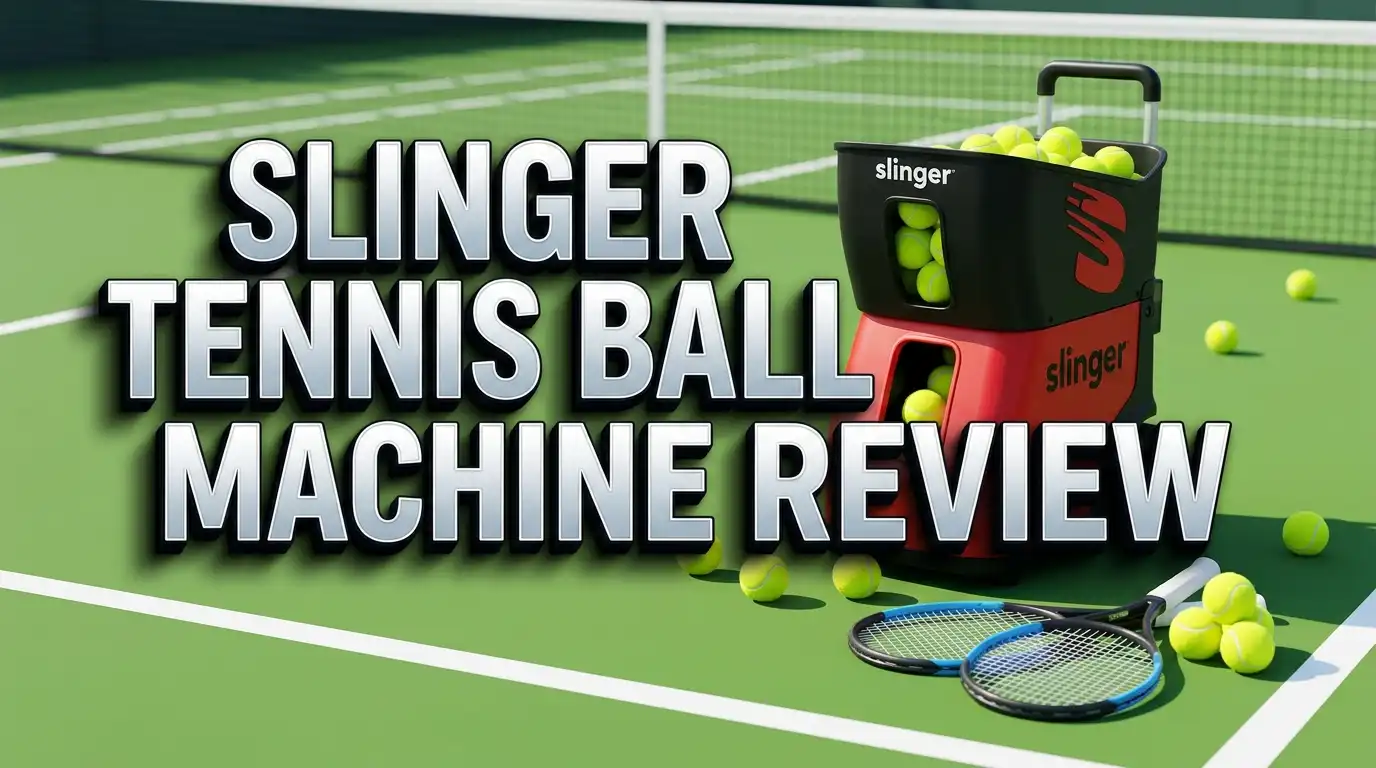
Its all-in-one design sets it apart from traditional ball machines. Most machines require a separate ball hopper, a cart, and a bag for your rackets. The Slinger combines all of this into a single rolling bag. This saves time and makes it easy to carry from the car to the court.
Design and Build Quality
The Slinger looks more like a premium rolling suitcase than a tennis ball machine. It has a sleek exterior with multiple zippered compartments. Two smooth rubber wheels sit at the bottom, and a telescopic handle extends from the back for easy rolling.
The top section holds up to 144 tennis balls. Below that is the launching mechanism. Side pockets store the charger, remote key fob, and small accessories. A rear compartment fits up to three tennis rackets.
Build quality is solid for the price. The zippers feel durable. The wheels roll smoothly across hard courts, asphalt, and indoor surfaces. The telescopic handle clicks firmly into place.
The ball collector tube straps to the side of the bag. It holds 20 balls and extends to help you pick up balls without bending over. This small addition saves energy during long practice sessions.
Setting Up the Slinger Bag
Setup takes less than two minutes once you arrive at the court. First, unzip the front bottom pocket and fasten it open with the included carabiner clip. This exposes the launching wheel.
Turn on the machine with the rocker switch on the control panel. Two dials let you adjust the ball speed and feed rate. Four LED lights show the remaining battery level.
Open the side pocket to access the elevation knob. This controls the launch angle between 10 and 40 degrees. Loosen the knob, set your angle, and tighten it. Then open the top compartment so the balls can shuffle freely into the hopper.
If you plan to use the oscillator, place the bag onto the oscillator base so the wheels sit in the grooves. Connect the magnetic cable to the control panel. You can then activate it from the remote control key fob.
Pro tip: Before you run to the baseline, stand next to the machine and use the remote to fire a few test balls. This lets you see where the balls land and adjust settings before you start hitting.
Top 3 Alternatives for Slinger Tennis Ball Machine
If the Slinger does not fit your needs or budget, here are three strong alternatives worth considering.

- Use Phone to Program each Shot for Speed, Spin, Height, Angle and Feed Rate.. No additional Cost for...
- Any Type of Oscillation Can be Easily Made By the Player Model.
Last update on 2026-07-15 / Affiliate links / Images from Amazon Product Advertising API

- ADJUSTABLE BALL SPEED & SPIN CONTROL: Fine-tune your practice sessions with adjustable ball speeds...
- TRIPLE OSCILLATION: Simulate match play by combining both vertical and horizontal oscillation...
Last update on 2026-07-15 / Affiliate links / Images from Amazon Product Advertising API

- LIGHTWEIGHT AND SMALL: Designed for maximum durability, this tennis ball machine has been...
- EASY TO TRANSPORT: The Nisplay tennis ball machine is easy to transport in your car. Its oversized...
Last update on 2026-07-15 / Affiliate links / Images from Amazon Product Advertising API
The Spinshot Player (B016UYMFS4) offers phone-controlled drills, topspin and backspin options, and speeds up to 80 mph. It costs more but gives advanced players full drill programming through a free app. The Lobster Elite (B0711DMJTG) provides preloaded drills, adjustable spin control, and speeds up to 80 mph. It is a trusted name among tennis coaches and clubs. The Nisplay N2 (B0BW69JC5G) is a compact, 26-lb machine with dual motors for topspin and backspin. It maxes out at 68 mph and holds 80+ balls. It sits in a similar price range to the Slinger and offers strong value.
Ball Speed and Spin Performance
The Slinger launches balls between 10 and 45 mph. This range suits beginners, intermediate players, and most recreational players. It will not challenge advanced tournament players who face 80+ mph groundstrokes in competition.
What really stands out is the topspin quality. The single-wheel system generates a heavy, penetrating topspin on every ball. The ball kicks up high off the court. This forces you to handle shoulder-height bounces and develop stronger swing paths.
Many users report that this topspin feels more like facing a strong club player than a generic ball machine feed. You will face balls that jump off the court and push you back. This is excellent practice for real match play.
The downside is you cannot switch to flat or backspin feeds. If you want to practice against slice or flat shots, you will need a different machine or a hitting partner. For most recreational players, the topspin focus is a benefit rather than a limitation.
Battery Life and Charging
The Slinger uses a lithium-ion battery rated for up to 3.5 hours. This figure applies to low-to-mid speed settings with normal feed rates. If you run the machine at maximum speed with the oscillator active, battery life drops closer to 1.5 hours.
Charging is simple. Plug the included charger into the port on the machine. Or remove the battery and charge it separately. A full charge takes a few hours. You can also buy a spare battery and swap them between sessions.
Four LED indicator lights on the control panel show how much charge remains. This is useful but not precise. An LCD screen with a percentage readout would be a welcome upgrade.
Best practice: Charge the Slinger after every session. Running out of battery mid-practice is frustrating. If you play multiple sessions per day, carry a spare battery.
Remote Control and Oscillator
The Slinger includes a small key fob remote control. It turns the machine on and off and activates the oscillator. The remote is simple and easy to use with one hand.
However, the remote cannot adjust ball speed or feed rate from the other side of the court. You must walk back to the machine to turn the dials. This is a drawback if you like to tweak settings between drills.
The oscillator is a separate accessory that comes with the Tournament and Grand Slam packs. It adds horizontal side-to-side sweep. With the oscillator on, balls land across different parts of the court. This turns a static drill into a full-court movement workout.
The oscillator base adds extra weight and bulk. You carry it in a separate small bag. It connects to the machine with a magnetic cable. Setup is easy, but the extra piece can feel inconvenient if you like to travel light.
What Can You Practice with the Slinger?
The Slinger supports a wide range of drills despite its simple controls. You can practice groundstrokes, volleys, half volleys, drive volleys, overheads, lobs, and footwork patterns by adjusting the machine position and settings.
For groundstroke practice, place the machine behind the service T with the speed at about 60%. Set the elevation to around 15 degrees. This delivers a comfortable mid-court ball for warm-up and groove work.
For overhead practice, put the machine inside the baseline on the center line. Set speed near maximum and elevation to 40 degrees. The ball arcs up like a lob, and you can practice back-pedaling and smashing.
For short ball drills, place the machine on your side of the net. Set speed low and elevation high. This simulates a hand-fed ball. Step in, hit, recover, and repeat. This drill builds better footwork and court movement.
For cross-court rallies, position the machine near the sideline, a couple of feet inside the baseline. Angle it diagonally. Hit cross-court forehands, then go down the line. Add the oscillator for extra challenge.
Portability and Transport
Portability is the Slinger’s biggest selling point. At 33 lbs empty, it is lighter than most competing machines. The Lobster Elite weighs 40 lbs. The Spinfire Pro 2 weighs 53 lbs. The Slinger beats them all.
The rubber wheels roll smoothly on paved surfaces and hard courts. The telescopic handle makes it feel like pulling a carry-on bag through an airport. You can wheel it from the parking lot to the court in one easy trip.
It fits comfortably in the trunk of a mid-size car or SUV. You do not need to remove wheels or disassemble parts. Open the trunk, slide it in, and go.
Stairs and gravel are harder. The bag is light enough to lift and carry for short distances. You can manage three flights of stairs without too much trouble. But it is not as easy as carrying a backpack-style machine like the Nisplay L1.
Slinger Tennis Ball Machine: Pros and Cons
Pros: The all-in-one bag design stores your machine, balls, rackets, and accessories in one place. The heavy topspin output creates match-like ball quality. The lightweight build makes transport effortless. The price point sits well below premium alternatives.
Cons: The maximum speed of 45 mph may feel slow for advanced players. The remote control lacks speed and feed adjustments. The single-wheel system only produces topspin. Some users report balls getting stuck at the edge of the hopper, though the latest 3.0 version has addressed this issue.
The oscillator adds bulk as a separate accessory. Battery life is decent but drops quickly at max settings. The LED battery indicator is vague compared to a numeric display.
Overall, the pros outweigh the cons for the target audience. If you are a recreational player or a coach, the Slinger offers strong value for money in 2026.
Who Should Buy the Slinger Tennis Ball Machine?
The Slinger is ideal for recreational players rated between 2.5 and 4.5 NTRP. If you want a personal practice machine that you can throw in the car and use at any open court, this is the best option in its price range.
It also works well for tennis coaches who run one-on-one lessons. Set up the Slinger to feed balls while you stand to the side and watch your student’s technique. It frees your hands so you can observe, record, and give real-time coaching.
Junior players and their parents benefit too. The topspin output challenges young players to develop better swing mechanics. It builds confidence against heavy balls that they will face as they move up levels.
The Slinger is not the best choice for advanced tournament players who need 70+ mph ball speeds, backspin variation, and programmable drill sequences. Those players should look at the Spinshot Player Plus-2 or the Lobster Elite Grand series.
Slinger vs. Spinshot vs. Lobster: Quick Comparison
The Slinger costs around $649 to $800 and tops out at 45 mph. It holds 144 balls, weighs 33 lbs, and only produces topspin. Battery life runs 3.5 hours. It has no app control or programmable drills.
The Spinshot Player costs around $1,500+ and reaches 80 mph. It holds 120 balls, weighs about 45 lbs, and offers topspin plus backspin. It supports phone-controlled drills through a free app with custom shot programming.
The Lobster Elite series costs $1,200 to $2,500 and fires up to 80 mph. It holds 150 balls, weighs 40 lbs, and includes spin control. Higher models offer preloaded drills and two-line oscillation.
If budget and portability matter most, the Slinger wins. If you need speed, spin variety, and drill programming, the Spinshot and Lobster are better picks. Choose based on your skill level, budget, and training goals.
Tips and Tricks for Getting the Most from Your Slinger
Charge before every session. The battery does not have a precise gauge, so keeping it fully charged avoids surprises. Carry a spare battery if you play multiple sessions per day.
Use pressureless tennis balls for the best results. The Wilson Triniti and Babolat Gold Academy balls work well. Pressureless balls last longer and perform consistently in ball machines.
Keep a small vacuum handy. Tennis ball fuzz builds up on the control panel and inside the hopper. A handheld mini vacuum or soft brush removes it quickly. Cleaning the machine regularly keeps it running smoothly.
Carry a spare CR2016 battery for the remote key fob. A dead remote means you cannot start the machine. Pack a small screwdriver and a couple of coin batteries in the side pocket.
Buy a second ball collector tube. Use one in each hand to collect balls faster. This reduces downtime and lets you spend more time hitting and less time bending over.
Is the Slinger Tennis Ball Machine Worth It in 2026?
- Slinger is a portable tennis bag that can easily transform to a Tennis Ball Launcher. Launching...
- We have created a unique Oscillator plate on which the slinger bag can sit and which allows the...
Last update on 2026-07-15 / Affiliate links / Images from Amazon Product Advertising API
Yes. The Slinger Tennis Ball Machine remains one of the best value ball machines you can buy in 2026. It delivers solid topspin, holds a large number of balls, and fits inside one portable bag. The price sits well below most serious competitors.
The machine is perfect for players who practice alone two or three times per week. It gives you a consistent, reliable feed so you can work on technique without relying on a hitting partner. The all-in-one design makes the experience convenient from car to court.
The competition has grown since the Slinger first launched. Machines like the Nisplay N2 and PT-Smart offer app control at similar price points. Still, the Slinger’s unique bag format and build quality keep it relevant and popular.
If you want a no-fuss, grab-and-go ball machine with honest performance, the Slinger Tennis Ball Machine earns a strong recommendation. It may not have every feature, but it does the important things well.
Frequently Asked Questions
How fast does the Slinger Tennis Ball Machine shoot?
The Slinger fires balls between 10 and 45 mph. This range covers warm-up feeds, medium-paced groundstrokes, and moderately fast drills. It produces strong topspin on every ball. The speed is suitable for beginners and intermediate players. Advanced players who need 70+ mph speeds should consider machines from Spinshot or Lobster.
How many balls does the Slinger hold?
The Slinger holds up to 144 tennis balls inside its built-in ball hopper. For the best launching performance, Slinger recommends loading about 72 balls at a time. This gives the balls enough room to feed smoothly into the rotating mechanism and avoids jams.
How long does the Slinger battery last?
The lithium-ion battery lasts up to 3.5 hours on low-to-mid settings. At maximum speed with the oscillator running, expect closer to 1.5 hours. The battery is removable. You can charge it inside the machine or take it out and charge it separately. A spare battery is available for purchase.
Can the Slinger produce backspin or flat shots?
No. The Slinger uses a single-wheel launch system that only produces topspin. It cannot fire flat or backspin balls. This is a limitation for players who want varied spin types. However, the topspin quality is excellent and creates a heavy, match-like ball.
Is the Slinger good for kids and juniors?
The Slinger works well for juniors who can handle balls that bounce above waist height. The heavy topspin may challenge very young beginners. For older juniors and teens, the Slinger provides excellent practice. The low speed setting (10 mph) helps ease younger players into machine practice gradually.
Does the Slinger come with a warranty?
The Slinger comes with a manufacturer warranty. Check the official Slinger Bag website or the retailer for specific warranty details and duration. The machine is sold through the Slinger website, Tennis Warehouse, and select online retailers.